
SEO Process
SEO PROCESS
SEO has changed. Ranking for keywords was never the whole job.
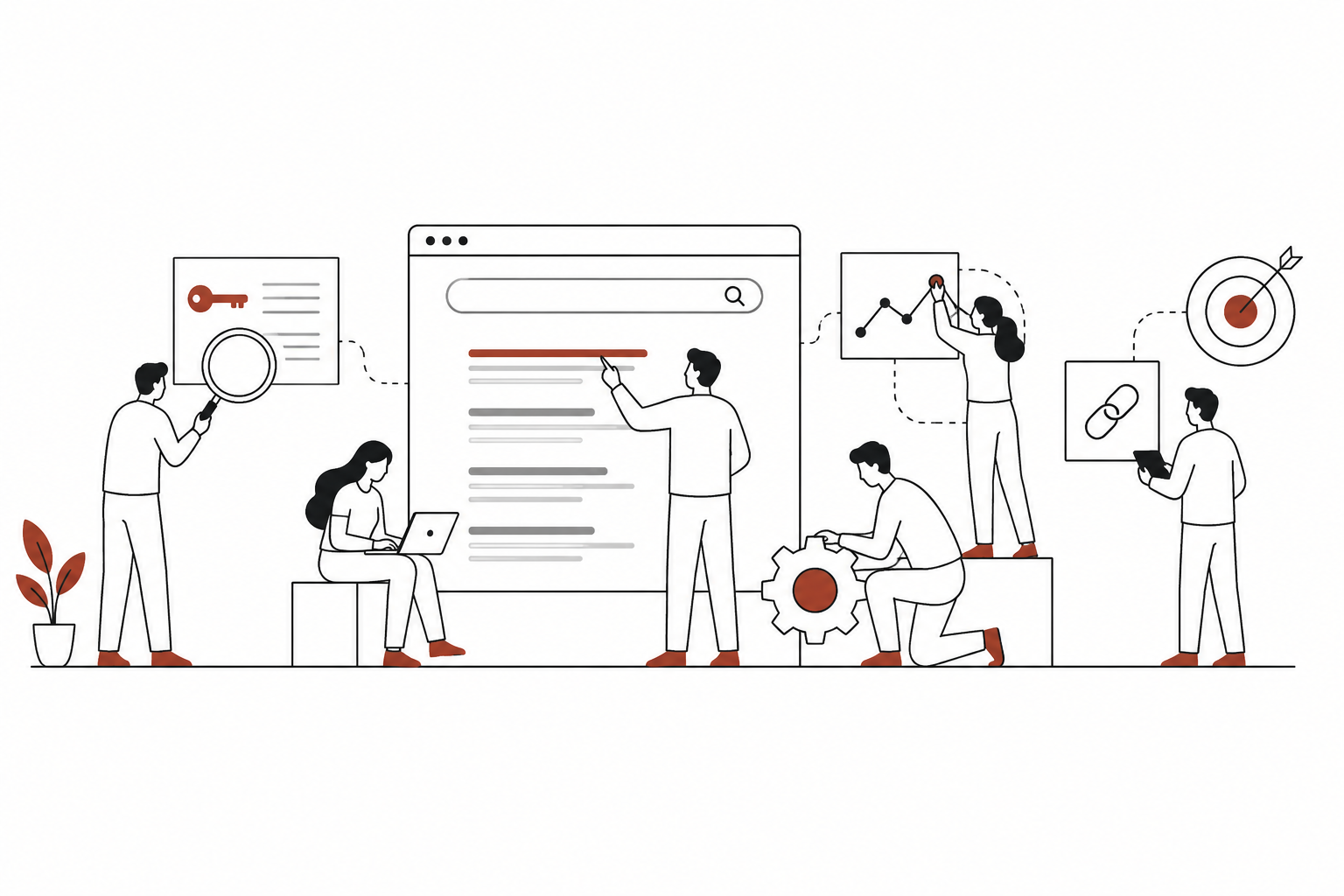
The goal is not more traffic. It's more of the right traffic.
Our SEO Process
Twelve steps, one continuous cycle.
01
We start with your business, not keywords
Before researching a single keyword, we understand your business — what you sell, who your ideal customers are, which products or services matter most, where you operate, who you compete with and what you want SEO to achieve. This prevents SEO from becoming a race for traffic with no business value.
02
We audit your current search presence
We review your rankings, organic traffic, indexed pages, website structure, technical health, existing content, internal links, backlinks, page experience and conversion journey — and look for missed opportunities sitting just outside strong ranking positions.
03
We understand how your customers search
Keyword research still matters, but collecting thousands of keywords isn’t a strategy. We study the questions your customers ask, the problems they want solved, the alternatives they compare and the language they use — then organise these searches around topics and intent.
04
We build your search architecture
We decide where each important topic should live on your website — a service page, a detailed guide, a category or location page, a comparison, a case study, an FAQ. This creates a logical site where every page has a purpose, and makes it easier for search engines and AI systems to understand what you know.
05
We fix the technical foundation
Even excellent content struggles if search engines can’t crawl, understand or index the website. We review crawling, indexing, site structure, canonicalisation, redirects, broken links, XML sitemaps, mobile usability, speed, Core Web Vitals and structured data — prioritised by actual impact, not tool warnings.
06
We optimise the pages that matter
We strengthen titles, headings, content structure, relevance, internal links, FAQs, images and calls to action on your highest-value pages. Every important page should clearly answer three questions: what is this about, who is it for, and why should someone trust and choose this business?
AI has made good content more important, not less
07
We create content worth finding
AI has made it easy to produce average content — which is exactly why average content has become less valuable. We focus on genuine expertise, practical advice, first-hand experience and real answers to real questions. If a page adds nothing useful, there’s little reason for people, search engines or AI to value it.
08
We build topical authority
Authority is rarely built by one article. We build connected content around the subjects your business genuinely knows well, moving from “we’ve written about this topic” to “this is one of the subjects our business is known for.”
09
We prepare your content for AI-led search
AI search doesn’t call for a separate website or new tricks — the fundamentals stay familiar. Information needs to be accessible, clearly written, accurate and trustworthy, with original experience visible and claims backed by context. The aim isn’t to trick AI into a mention — it’s to become a source worth mentioning.
10
We build authority beyond your website
Saying you’re an expert matters more when other credible sources recognise you too. We work on relevant backlinks, brand mentions, expert contributions, industry publications, digital PR and genuine authority opportunities — not hundreds of meaningless links.
11
We improve before we keep adding
Many websites already have dozens of pages that are outdated, repetitive or competing against each other. We regularly review existing content to improve, expand, combine, redirect or remove it. Sometimes the fastest way to improve a website isn’t to publish more — it’s to make what already exists much better.
12
We measure, learn and improve
We track visibility, which pages attract visitors, what people search for and which pages convert. A number-one ranking has little business value if nobody relevant searches for it or the traffic never converts — so real performance data decides what gets built next.
Our SEO Growth Loop
SEO isn't a project you finish once.
Search behaviour changes. Competitors change. Websites change. AI changes how information is discovered. A strong strategy keeps adapting with them.


First 90 Days
What happens in the first 90 days?

Days 1–30
Understand & fix
Building the foundation — we understand the business, audit the website, research the market and search landscape, analyse competitors, identify technical problems and decide where the SEO effort needs to go.
Days 31–60
Optimise & build
The strategy starts becoming visible on the website. Priority pages are improved, technical issues addressed, internal linking strengthened, and new content begins to take shape.
Days 61–90
Expand & learn
Actual search performance starts guiding the next moves — developing useful content, strengthening authority and looking for new opportunities. This is where compounding begins.
Does SEO Still Work?
Does SEO Still Work?
Yes. Old SEO Doesn't.
SEO is not Dead. It is Evolving.
Keyword stuffing, mass-produced articles, meaningless backlinks and pages built purely to target search phrases aren’t a sustainable strategy anymore. Modern SEO is much closer to building a genuinely useful digital presence.
People still need to find businesses, solve problems, research subjects, compare choices, check credibility and make decisions. AI doesn’t remove those needs — it changes how people fulfil them.
SEO isn’t disappearing. It’s evolving with search.

Frequently Asked Questions
No. AI is changing how people search and how answers are presented, but it hasn’t removed the need for businesses and information to be discovered. As more content gets created with AI, credible sources, real expertise and trusted brands become even more important.
Some informational searches will get fewer clicks since users get an answer directly. But people still visit websites for deeper information, to compare options, verify credibility, enquire, book or buy — which makes attracting the right searches more important than chasing traffic volume.
There’s a large overlap. Strong technical accessibility, clear content, original expertise and trustworthy information support visibility across traditional and AI-led search. We build strong search foundations that work across changing discovery platforms, rather than treating AI optimisation as a collection of tricks.
No — just as nobody can responsibly guarantee a number-one Google ranking, nobody can guarantee an AI system will mention or cite a business. What we can do is make your website and brand easier to understand, verify and trust.
Yes. Keywords tell us what people search for and how they describe their needs. Modern SEO goes further than exact keywords though — we focus on the meaning, intent and context behind the search.
Yes, when there’s something useful to say. We don’t recommend publishing generic articles just to increase page count — a strong article should answer a genuine question, demonstrate expertise or help a potential customer decide.
Yes — AI can help with research, analysis, organisation and content development. But using it to mass-produce generic articles isn’t a strong content strategy. Human expertise, original thinking, examples and editorial judgement remain important.
Yes, but relevance and quality matter more than volume. A credible mention or link from a respected source can be far more valuable than dozens of random links created purely for SEO.
SEO is a long-term channel. Some technical fixes and existing-page improvements can show results relatively quickly, while competitive searches may take months of sustained work — the timeline depends on your starting point, competition and market.
No. Search rankings are controlled by search engines and constantly change. We focus on building the strongest possible foundation for relevant, sustainable organic visibility.
No. A one-time project can fix specific problems, but long-term growth needs ongoing work — competitors publish new content, search behaviour changes, pages go outdated and search technology evolves.
Frequently Asked Questions
Questions we hear often
Is SEO dead because of AI?
No. AI is changing how people search and how answers are presented, but it hasn’t removed the need for businesses and information to be discovered. As more content gets created with AI, credible sources, real expertise and trusted brands become even more important.
Will people still visit websites if AI gives them the answer?
Some informational searches will get fewer clicks since users get an answer directly. But people still visit websites for deeper information, to compare options, verify credibility, enquire, book or buy — which makes attracting the right searches more important than chasing traffic volume.
What's the difference between SEO and AI search optimisation?
There’s a large overlap. Strong technical accessibility, clear content, original expertise and trustworthy information support visibility across traditional and AI-led search. We build strong search foundations that work across changing discovery platforms, rather than treating AI optimisation as a collection of tricks.
Can SEO guarantee our brand appears in AI answers?
No — just as nobody can responsibly guarantee a number-one Google ranking, nobody can guarantee an AI system will mention or cite a business. What we can do is make your website and brand easier to understand, verify and trust.
Do keywords still matter?
Yes. Keywords tell us what people search for and how they describe their needs. Modern SEO goes further than exact keywords though — we focus on the meaning, intent and context behind the search.
Should we still create blogs?
Yes, when there’s something useful to say. We don’t recommend publishing generic articles just to increase page count — a strong article should answer a genuine question, demonstrate expertise or help a potential customer decide.
Can AI be used for SEO content?
Yes — AI can help with research, analysis, organisation and content development. But using it to mass-produce generic articles isn’t a strong content strategy. Human expertise, original thinking, examples and editorial judgement remain important.
Do backlinks still matter?
Yes, but relevance and quality matter more than volume. A credible mention or link from a respected source can be far more valuable than dozens of random links created purely for SEO.
How long does SEO take?
SEO is a long-term channel. Some technical fixes and existing-page improvements can show results relatively quickly, while competitive searches may take months of sustained work — the timeline depends on your starting point, competition and market.
Can you guarantee first-page Google rankings?
No. Search rankings are controlled by search engines and constantly change. We focus on building the strongest possible foundation for relevant, sustainable organic visibility.
Is SEO a one-time activity?
No. A one-time project can fix specific problems, but long-term growth needs ongoing work — competitors publish new content, search behaviour changes, pages go outdated and search technology evolves.